EV Charging Usage Notes
EV Charging Usage Notes — Usage information about
the EV Charging solution
Description
The section contains information about how to use the Speedgoat EV Charging
solution and the respective Simulink driver blocks.
Charge Cycle Flowchart
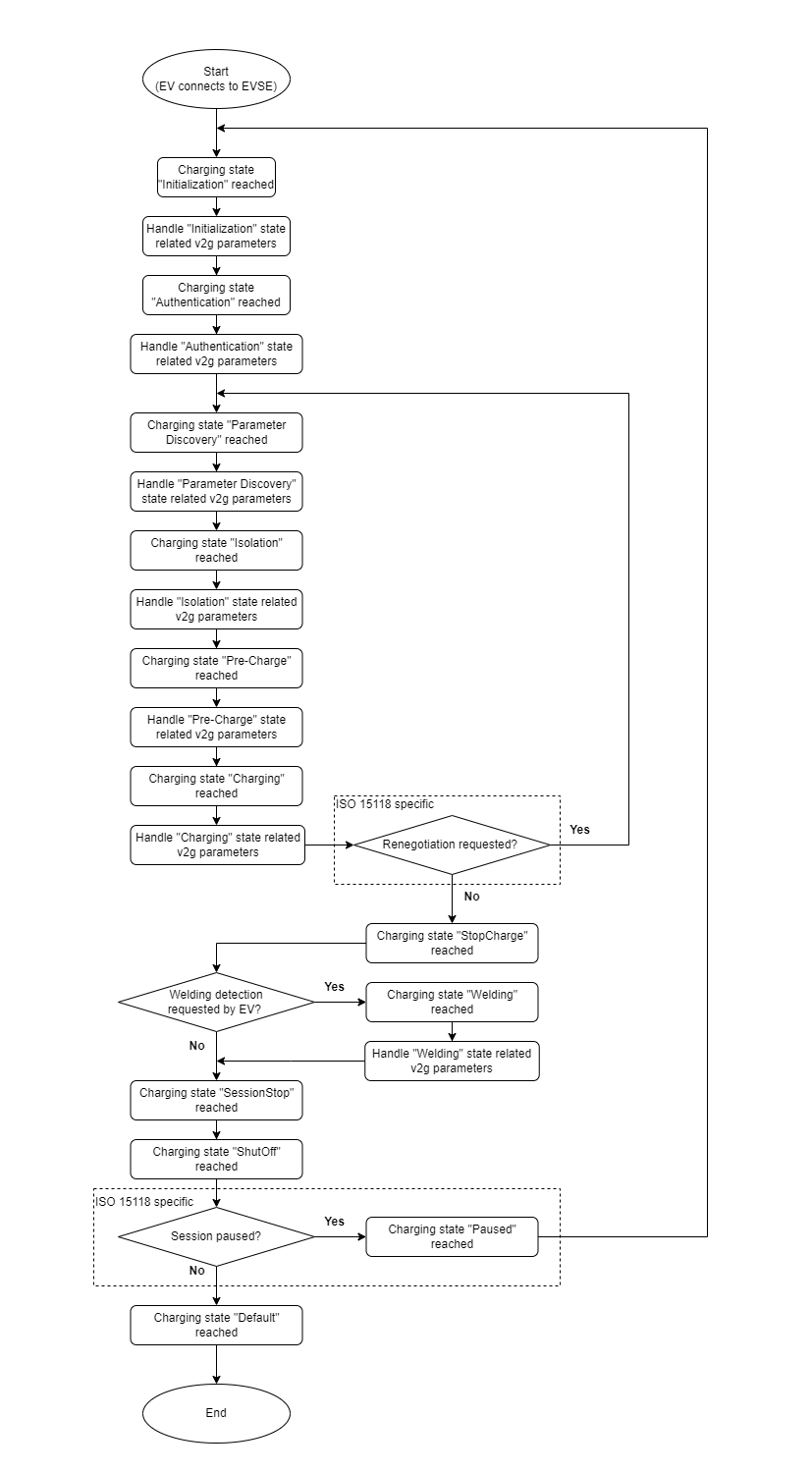
The following flowchart illustrates a typical charging sequence with the charging
states of an ISO/DIN charging session.
Best Practices for DC Charging
The following description summarizes all major steps to provide a charge control
algorithm for DC-charging:
Check if the EV is plugged and a CP connection is established (CP State
'B' received over topic TOPIC_CHARGE_CP_STATUS and TOPIC_CHARGE_TCP_STATUS
with "connected" ('1' tcp or '2' tcp with tls)
Observe the CP States and the TCP connection status throughout the whole
charging session
Use the status topics to indicate the current Charging state
Analyse the subscribed MQTT EV topics and handle the EVSE topics according
to the standard (ISO 15118 / DIN 70121)
Initialization State
Authentication State
Parameter Discovery State
If the charge parameter state has finished on EVSE side,
the EVSE Processing parameter of the "PARAMETER" state needs
to be set to "Finished" ('0') and the EVSE Statuscode shall
be set to "EVSE_Ready" ('1')
If EVSE Processing was set to "Finished" ('0') the
connector has to be locked on EV-side
In ISO 15118, an SA-schedule must be sent over topic EVSE
SA-Schedule. One schedule is already pre-configured by the
charging-stack, but this one should be adapted with valid
data. A list entry can be overwritten by using the
SA-Schedule inputs of the Simulink block. The pre-configured
SA-schedule is using SA-Schedule Tuple ID '1'
Isolation State
If the EVSE is performing the isolation check, the
Statuscode shall be set to "EVSE_IsolationMonitoringActive"
('4')
If the cable status is successfully checked, the
Isolationstatus should be set to "Valid" ('1') or whatever
its result is. The isolation status should be observed and
updated throughout the whole Charging state. If the
isolation status is "valid" ('1') or "warning" ('2'), the
EVSE Statuscode must be set to "EVSE_Ready" ('1')
If the isolation check has finished on EVSE side, the EVSE
Processing parameter of the "ISOLATION" state needs to be
set to "Finished" ('0')
Pre-Charge State
If the EVSE is ready, the Statuscode shall be set to
"Ready" ('1')
The EVSE Present Voltage must be ramped up to the
requested EV Target Voltage
The pre charge state is finished by the EV when it
considers the voltage to be successfully adjusted
Charging State
The EVSE shall follow the requested EV target voltage and
target current under the conditions of the handled maximum
and minimum limits
The topic EV Ready to Charge State indicates the current
charge progress of the EV. If it is set to "Start" ('0') or
"Stop" ('1'), the EV requests to start or stop the energy
flow. If it is set to "Renegotiate" ('2'), the EV requests
the renegotiation process. (Only relevant for ISO
15118)
Welding State
At the end of a charging session the EV can perform a
welding detection to ensure that the contactors are not
welded. It is a sequence of opening and closing of the
contactors and simultaneous observing the voltage
If the EVSE is ready, the Statuscode shall be set to
"Ready" ('1')
During the Welding state, it is advised to drop the actual
EVSE voltage to zero
The EV decides when it is ready to leave the state
Initiate a shutdown of the power electronics, if the EV indicates to stop
charging or for EVSE emergency reasons
The charging session is terminated by receiving the status topic TCP with
"disconnected" ('0') and status topic CP with state 'A'