I2C - Slave setup v1
I2C - Slave setup v1 — The I2C Slave setup block
allows an identifier (slaveID) to be assigned to the I2CS blocks. In addition,
the Register Addressing of the I2CS can be enabled or
disabled.
Library
Simulink Real-Time - Speedgoat
Description
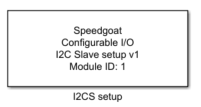
The I2C Slave setup block allows an identifier (slaveID) to be assigned to the
I2CS blocks. In addition, the Register Addressing of the I2CS can be enabled or
disabled.
If the Skip Register Addressing parameter is
unchecked, the I2CS expects to receive a subindex byte prior to a write access on
the registers of the I2CS. This subindex byte sets the pointer to the slave register
address where the following read or write accesses will be done. An auto-increment
flag is enabled so that multiple read or write accesses can be performed on
consecutive register addresses. The encoding of the subindex byte for the I2CS
implementation looks as follows: - bit 7-0: register address (0..256)
If Skip Register Addressing" is checked, the I2C
slave block will no longer expect to receive a sub-index (register address) prior to
a write access. Both accesses, write and read, will be performed on the first
register of I2CS.
Ports
This block has no inputs and no outputs.
Parameters
-
Configurable I/O Module ID
This parameter associates a code module block with a configurable I/O module setup
block. Set this value to match the Module ID defined in the setup block of the
required configurable I/O module.
-
Channel
The number of the channel which this driver block entity will access. Only one
channel per driver block can be addressed. You can specify channels in the range 1-N
(N = the number of channels implemented in your specific configuration file defined
in the Setup block).
-
Slave Identifier
A unique identifier for the slave. The identifier size is 7 bits.
-
Skip Register Addressing
If enabled, the register addressing of the I2CS is skipped. The I2C
slave block will no longer expect to receive a sub-index (register
address) prior to a write access. Both accesses, write and read, will be
performed on the first register of I2CS.