OPC UA - Client Connection
OPC UA - Client Connection — Connects the local OPC
UA client with one remote OPC UA server
Library
Simulink Real-Time - Speedgoat
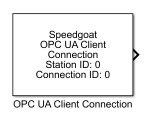
Description
The Connection block connects the local OPC UA client with one remote OPC UA
server. Each server connection requires a Connection block in the model. The
connection start point is given by the local IP address, entered in the Setup block
mask, and a random TCP port. The connection endpoint is given by the IP address and
TCP port of the remote server. Enter both remote parameters in the Connection block
mask.
Ports
Outputs
-
Connection Status
This port outputs the state of the client-server connection as an
array of data type UINT32 and length 3. The first index is the OPC UA
session state. The available values are:
The second index is the OPC UA secure channel state. The available
values are:
The third index is an error code. A valid connection is indicated
by
Inputs
This block does not have any input ports.
Parameters
General
-
Station ID
Apply the Station ID of the corresponding Setup block. Must range
between 0 and 65535.
-
Connection ID
The Connection ID is used to assign Read and Write blocks to a
particular client-server connection. Connection IDs range between 0 to
65535 and must be unique along all Connections blocks of the client
(these blocks have the same Station ID).
-
Remote Address
Enter the IP address or URL of the remote OPC UA server. If the
Remote TCP Port parameter is 0, the
remote address must be a URL. In all other cases, the remote address
must be an IP address. Examples:
Remote TCP Port 4840 and Remote Address '192.168.1.50' prompts the
client to connect to port 4840 at 192.168.1.50
Remote TCP Port 0 and Remote Address 'opc.tcp://192.168.1.51:4841'
prompts the client to connect to port 4841 at 192.168.1.51
-
Remote TCP Port
Enter the TCP port the remote OPC UA server is listening on for
connection requests.
-
Sample Time
Defines the base sample time at which this driver block gets its sample hit. This
parameter can also be set to -1 for inherited
sample time. The units are in seconds.
Security
-
Security Policy
Select the security policy of the server endpoint to which the client
should connect.
-
Security Mode
Select the security mode of the server endpoint to which the client
should connect. If the security policy is None, the security mode must also be None.
-
User Token Policy
Select the user token policy for user authentication. If Username is selected, enter the user
credentials in the Username and
Password parameters. Furthermore,
you must provide a certificate and a private key as the remote server's
policy may require username and password encryption.
-
Certificate
Define the location of the public application instance certificate on
the host PC. The file must be an X509 DER file with extension *.cer.
During the build process, the file will be packed into the real-time
application and transferred to the target machine. The certificate is
required for security policies other than None. The X509v3 Subject Alternative Name property of
the certificate file must match the character array entered in the
Application URI parameter. You can
use the certificates included in the OPC UA product examples.
Data type: Character array
Default value: ''
-
Private Key
Define the location of the private key file on the host PC. The file
must be a PEM file with extension *.pem and must relate to the
certificate. During the build process, the file will be packed into the
real-time application and transferred to the target machine. The private
key is required for security policies other than None. You can use the private keys included in the OPC
UA product examples.
Data type: Character array
Default value: ''
-
Username
Specify the user name with which the client should log in to the
server.
Data type: Character array
Default value: ''
-
Password
Enter the password associated with the username.
Data type: Character array
Default value: ''
Identity
-
Application URI
The Application URI is a common identity property of all OPC UA
devices. When using certificates, the Application URI must match the
X509v3 Subject Alternative Name property of the certificate.