IO752 - Send v3
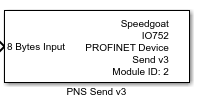
IO752 - Send v3 — Sends cyclic data to the remote
PROFINET controller.
Library
Simulink Real-Time - Speedgoat
Description
This block sends cyclic data to the remote PROFINET controller. For acyclic
communication, use Record blocks.
Your model can contain only one Receive block for each
I/O module in your target machine.
Ports
Inputs
The block writes the input data items of the sub-modules defined in
the Data Module Configuration parameter
of the corresponding Setup block. The number, types and dimensions of
the input ports depend on the mask parameters. The block has either:
one port for each data item
one port for each sub-module
one port for each module, or
one port in total that represents the entire input data of
the device
Outputs
This block does not have any output ports.
Parameters
-
Module ID
This ID defines the link to the corresponding Setup block
-
Sample Time
Defines the base sample time at which this driver block gets its sample hit. This
parameter can also be set to -1 for inherited
sample time. The units are in seconds.
![[Caution]](images/caution.png) | Caution |
|---|
All blocks that interface with the same I/O module must have identical
sample times. |
-
Input Level
Defines the granularity of the data input. There are 4 options:
Data Item: Each port represents one data item and inherits its
type and length from the Data Module
Configuration parameter of the corresponding
Setup block
Sub-Module: Each port represents one sub-module. The data
items of the sub-module are packed in a vector of data type
uint8
Module: Each port represents one module. The data items of the
module's sub-modules are packed in a vector of data type
uint8
Device: One port represents the entire input data of the
device as a vector of data type uint8
Use Byte Packing blocks to pack data items into byte vectors.
-
Group Data Items as Vector
If selected, the input ports expect the data items as a vector. This
reduces the number of ports and therefore improves usability. All data
items must be scalar and must have the same type. If the sub-module has
at least one data item of another data type, the parameter has no impact
and the block creates a port for every single data item.
-
Port Label Elements
Shows or hides specific elements of the input port label. The elements
available include the module name, the sub-module name and the name of
the data item. The resulting port label also depends on the Input Level parameter as you cannot show the
sub-module name if the input level is module, for example.