IO907/IO908 Usage Notes
IO907/IO908 Usage Notes — Usage information about the
I/O module
Setting the Node ID
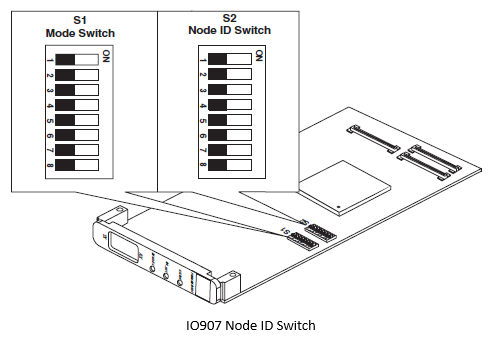
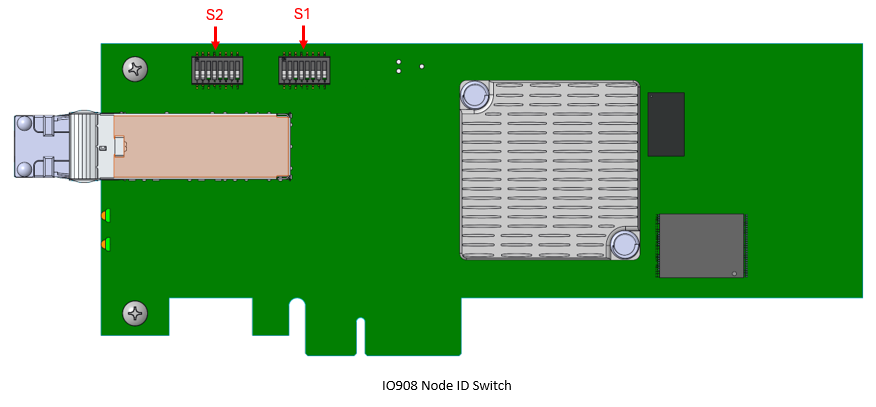
The switch bank S2 is used to assign a unique ID for the IO907/IO908 on the shared
memory network. By default Speedgoat assigns ID = 1. For deliveries with several
target machines, each system will have a different ID (1, 2, 3…), however it's
possible to change the ID at any time. Possible IDs are from 0 to 0xFF (255
decimal).
Network Wiring
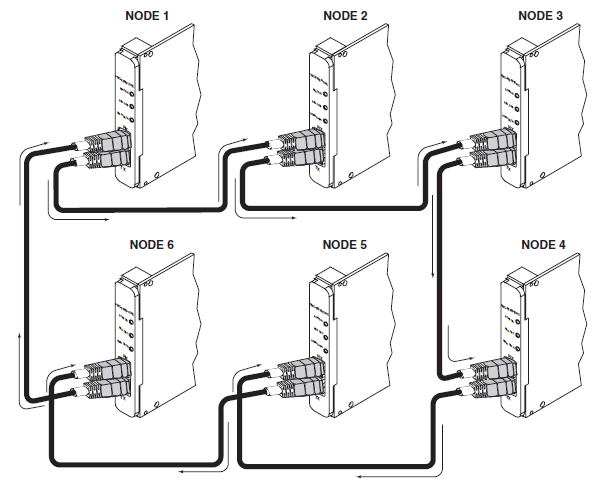
Each I/O module has two fiber optic connections, RX (receive) and TX (transmit).
When connecting two systems, a crossed connection is required. For networks with
several nodes, a ring connection is required.
For other network topology (e.g. star), the following hubs can be used (only for
IO907):
Shared Memory Initialization
The IO907/IO908 I/O modules need to be initialized. This can done with an M-file,
which is then loaded with your Simulink model.
Memory Partitions
For each variable, a partition must be defined. The example below shows how to
define the variables:
Partitions(1).Size = '1';
Partitions(1).Type = 'uint8';

Partitions(2).Size = '2';
Partitions(2).Type = 'double';

Partitions(3).Size = '1';
Partitions(3).Type = 'double';

Partitions(4).Size = '1';
Partitions(4).Type = 'uint8';

Partitions(5).Size = '2';
Partitions(5).Type = 'double';

Partitions(6).Size = '1';
Partitions(6).Type = 'double';
Partitions(6).Address = '0x5000';

Partitions = completepartitionstruct(Partitions,'5565');
For further information, function scgtpartitionstruct can be used.
Partition = scgtpartitionstruct(Partition);
You do not need to use all the fields of a partition initialization structure.
However, knowledge of the possible structure fields will be helpful when you are
setting up the partition structure to use shared memory.
A shared memory partition structure has the following fields:
The variables defined in the memory partition are used for read and write from all
shared memory nodes.
Nodes
Each shared memory I/O module installed needs to have a "node ID":
Master – Node ID = 1
MasterNode.Interface.NodeID = '1';
MasterNode.Partitions = Partitions;
MasterNode = completenodestruct(MasterNode,'5565');
Slave – Node ID = 2
SlaveNode.Interface.NodeID = '2';
SlaveNode.Interface.Interrupts.PendingInt1='on';
SlaveNode.Partitions = Partitions;
SlaveNode = completenodestruct(SlaveNode,'5565');
![[Note]](images/note.png) | Note |
|---|
Available Interrupts PendingInt1 PendingInt2 PendingInt3 PendingInit
|