Modbus - GOOSE Publisher
Modbus - GOOSE Publisher —
Publishes GOOSE data through MAC addressing.
Library
Simulink Real-Time - Speedgoat
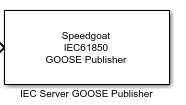
Description
This block is used to publish data to the network using a destination MAC address.
Your model can contain multiple IEC 61850 GOOSE publisher blocks and requires at
least one IEC 61850 Client or Server license.
Ports
Inputs
-
Input
Array of dynamic length that is published to the given Destination MAC Address. The data type is
specified in the Message Data Type
field using the Base Interval Time
parameters.
Use Byte Pack blocks to convert to signed values or floating-point
numbers. You can pack one double value to a vector of type int8 and
length 8.
Outputs
This block does not have any output ports.
Parameters
-
Ethernet Port
Define from which local Ethernet port GOOSE messages should be
published. The internal Ethernet interfaces of Speedgoat target machines
have for example 'ETH1' as an available port.
-
Message Data Type
Select one of the data types listed in the dropdown list:
Int8
1-byte signed integer.
Double
8-byte floating point.
Quality
4-byte unsigned integer.
Boolean
1 bit.
-
Base Interval Time
Define the base interval for publishing GOOSE messages. When a value
changes, the publishing interval is divided by 10 and then augmented in
2 steps until it reaches the base interval again.
-
Sample Time
Defines the base sample time at which this driver block gets its sample hit. This
parameter can also be set to -1 for inherited
sample time. The units are in seconds.
-
Destination MAC Address
Define the multicast/broadcast MAC address of the GOOSE message. For
the purpose of broadcasting use ff:ff:ff:ff:ff:ff.
-
GOOSE App ID
The GOOSE app ID will be inserted into the published message. This way
you can filter the messages when publishing on the same MAC
address.
-
VLAN ID
The VLAN identifier is used to tag a message. The values of 0 and 4095
(0x000 and 0xFFF in hexadecimal) are reserved. All other values may be
used as VLAN identifiers, allowing up to 4,094 VLANs.
Refer to this webpage for further information about VLAN parameters:
IEE_802.1Q Wiki.
-
VLAN Priority
The VLAN priority (priority code point (PCP)) sets the priority level
of the message.
Refer to this webpage for further information about VLAN parameters:
IEE_802.1Q Wiki.